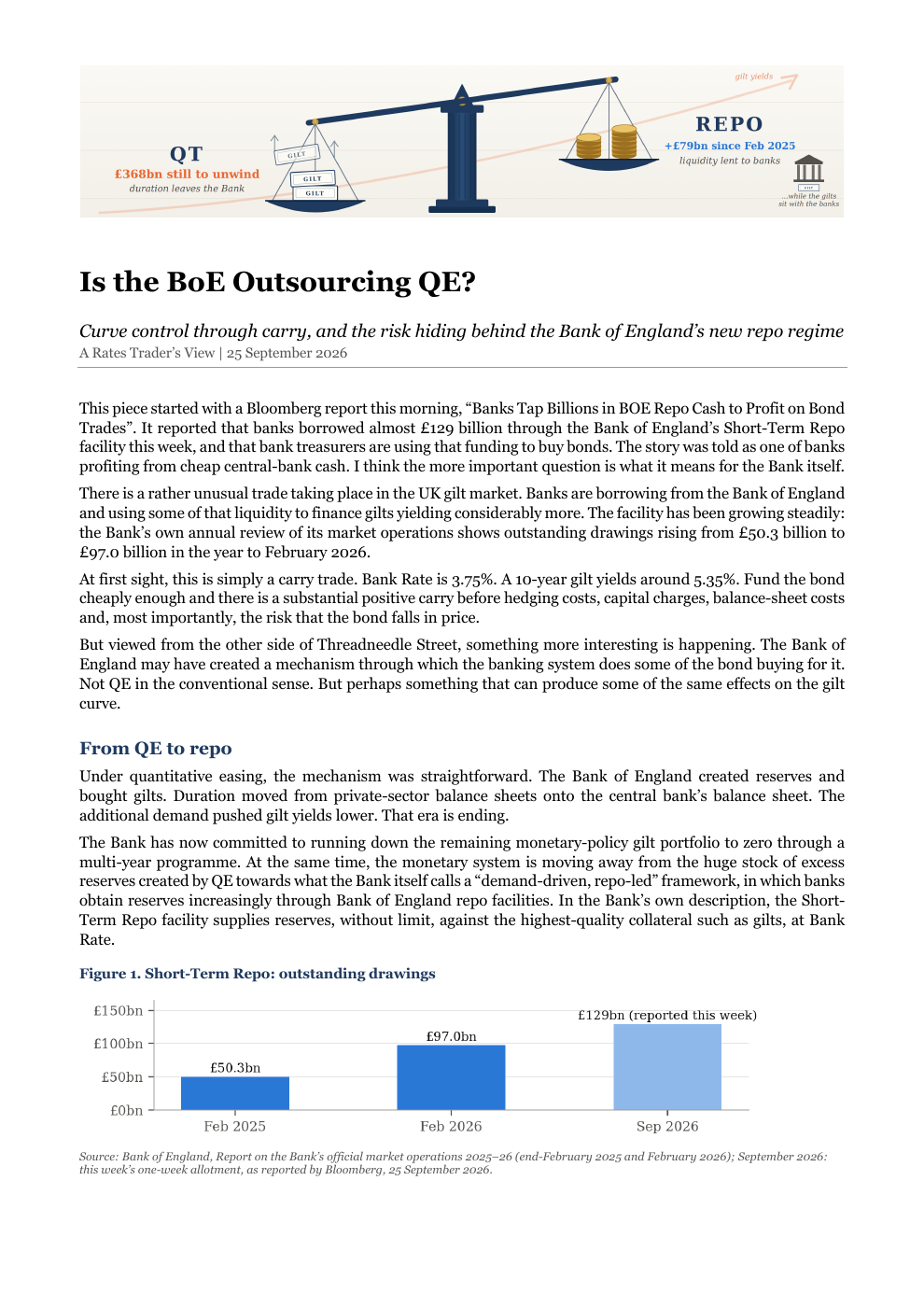
Banks are borrowing through the Bank of England's Short-Term Repo facility while gilt yields sit above Bank Rate. The question is whether that funding could enable private balance sheets to absorb some of the duration leaving the Bank under quantitative tightening—and what happens if the expected path of rates proves wrong.
The mechanism and its limits
The Bank supplies reserves against collateral; banks may finance gilts with them. That could support demand without the Bank buying the bonds itself. It is not quantitative easing: private holders retain duration, funding and mark-to-market risk, and much of the buying may be hedged.
This paper compares today's apparent carry with funding implied by the market's rate path, places repo growth alongside the scale of past QE and current QT, and asks when a stabilising bid could instead turn into selling pressure.
Repo and the gilt curve
How central-bank liquidity can finance private-sector demand while duration stays outside the Bank.
Carry versus the rate path
Why funding at today's Bank Rate gives a different picture from funding over the life of the position.
Other buyers
How tax-sensitive private demand for short, low-coupon gilts differs from bank and pension demand.
What could reverse the flow
Hikes, hedging, balance-sheet costs and the circumstances in which financed gilt holdings could shrink.
Full paper
This paper presents a general professional perspective on fixed-income markets. It does not describe a current portfolio, disclose proprietary positions or constitute investment advice or a recommendation concerning any instrument or strategy. Market levels and policy references are dated 24–25 September 2026; the analysis contains scenarios and assumptions, not forecasts.